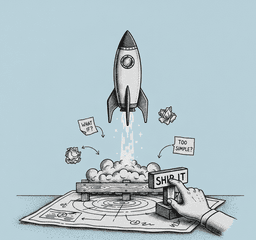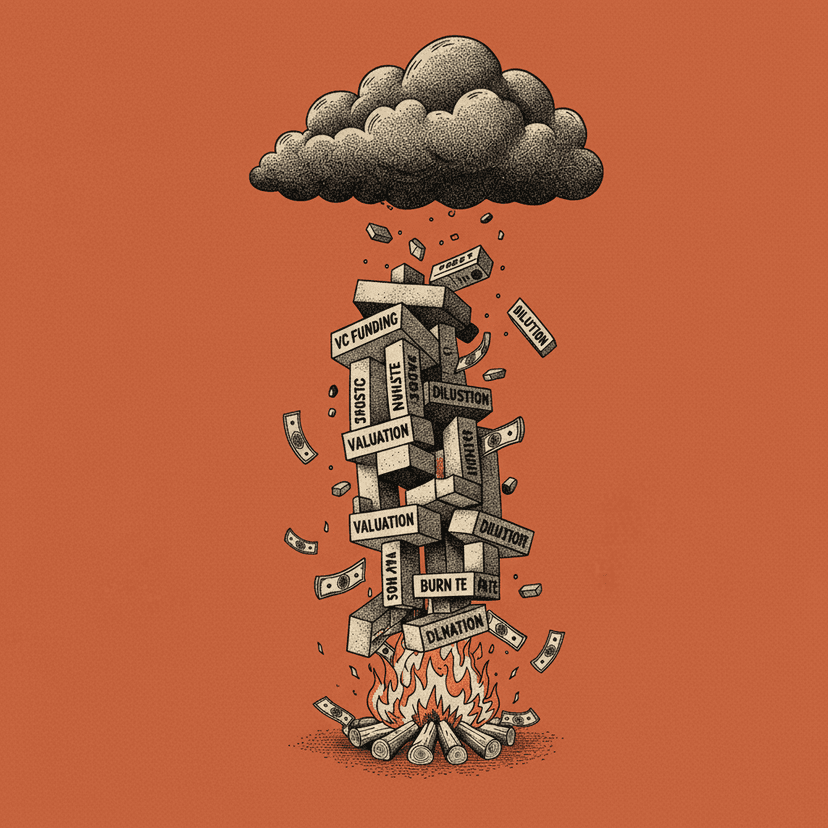
The modern startup ecosystem is built around a single default assumption: if you want to build something meaningful, you raise venture capital. Funding announcements fill the headlines, valuations are treated like achievements, and founders often feel that investment is not only an option but a requirement. But when you strip away the noise and look at the numbers, a very different picture emerges. Bootstrapped companies — the ones built on revenue instead of outside money — often outperform venture-backed companies across the metrics that matter most: survival, profitability, and long-term founder reward.
The first major difference appears in survival rates. Across multiple comparative analyses, bootstrapped companies demonstrate a significantly higher likelihood of surviving five years or more. The figures vary slightly by study, but most cluster around a 35–40% five-year survival rate for bootstrapped companies, compared to just 10–15% for VC-backed equivalents. This contrast is rarely discussed publicly, yet it reveals something fundamental about how each model behaves. Bootstrapped companies survive because they grow in direct proportion to customer demand; VC-backed companies die because their cost structures and growth expectations outpace reality. The presence of investment capital does not protect a company — it often accelerates the rate at which it hits structural flaws.
Profitability tells a similar story. Bootstrapped companies are forced to become financially disciplined from day one, and the result is a far higher likelihood of becoming sustainably profitable. Data from multiple summaries of startup outcomes suggests that roughly 25–30% of bootstrapped companies eventually reach meaningful profitability, while only 5–10% of venture-backed startups do. The difference is not philosophical; it is structural. Bootstrapped companies design themselves around revenue. Venture-backed companies design themselves around growth. Revenue is stable. Investment is temporary. When investment runs out, the economics of the business must stand on their own — and in many cases, they don’t.
The common assumption is that bootstrapped companies pay for their discipline with slower growth, but data from the SaaS sector challenges this as well. A ChartMogul study examining revenue growth across SaaS businesses found that top-performing bootstrapped companies reach $1M in annual recurring revenue in roughly two years. Top-performing venture-backed companies reach that milestone only a few months faster. In other words, once a bootstrapped company finds product–market fit, its growth trajectory looks remarkably similar to that of its funded peers — without the dilution, without the burn, and without the pressure to double or triple every year.
Revenue benchmarks reinforce the same point. A comparative analysis of 37 SaaS companies shows bootstrapped businesses achieving an average monthly recurring revenue of $364,000, with a median of $227,000. Venture-backed companies, as expected, operate at somewhat higher revenue levels — an average of around $599,000 and a median of roughly $329,000 — but the gap is far narrower than most founders assume. More importantly, bootstrapped companies typically achieve these figures with far fewer employees, far lower overhead, and significantly higher margins. Crucially, churn and retention do not differ meaningfully between the two groups. Customer loyalty is not something you can buy with venture capital.
Beyond performance metrics, the distribution of funding tells an even clearer story about the norms of successful business building. Up to 99% of startups never receive VC funding at all — not because they fail to qualify, but because they don’t need or seek it. Even among software companies with 50 or more employees, many remain entirely privately funded. The vast majority of profitable, durable companies in the economy — including in tech — are built without any venture support. Venture-backed companies make headlines, but they do not represent the modal path to business success. They represent an extreme.
But the single greatest difference between bootstrapped and venture-backed companies appears in founder outcomes. A bootstrapped founder who builds a business to even £1M in valuation — or a few hundred thousand pounds in annual profit — typically owns 100% of the company. They have full control, immediate access to profit, and no reliance on a future exit. A venture-backed founder who grows a business to £10M in valuation might own only 1–5% after multiple rounds of dilution. That equity is illiquid, dependent on a successful exit, and subordinate to investor preferences. Most VC-backed founders never see a significant return because most VC-backed companies never produce a significant exit.
This is why the mathematics of early ownership is so critical. A founder who keeps 100% of a calm, profitable £1M business can earn £250,000–£600,000 per year, depending on margins, with control, stability, and long-term compounding. A founder who owns 1% of a £10M venture-backed company owns £100,000 of illiquid paper value — not cash, not profit, not control. And because fewer than 10% of venture-backed startups reach a meaningful exit, the statistical founder outcome in the VC model is not wealth. It is disappointment.
Underlying all of this is a simple structural truth: bootstrapped businesses are built for durability, while venture-backed businesses are built for speed. Durability compounds. Speed burns. Bootstrapped companies focus on acquiring customers, reducing churn, improving margins, and building something that can sustain itself. Venture-backed companies focus on capturing markets quickly enough to justify the next round. When that speed is justified, the results can be spectacular. When it isn’t, the collapse is total.
The data makes one conclusion clear: for the vast majority of founders — especially in software — bootstrapping offers better odds of survival, a higher chance of profitability, and a far superior likelihood of meaningful personal reward. Venture capital remains an important instrument for specific types of businesses, but it is neither the default nor the optimal model for most. The more realistic, more stable, and more rewarding path is the one built on customers, not investors.












 Ollie Darby